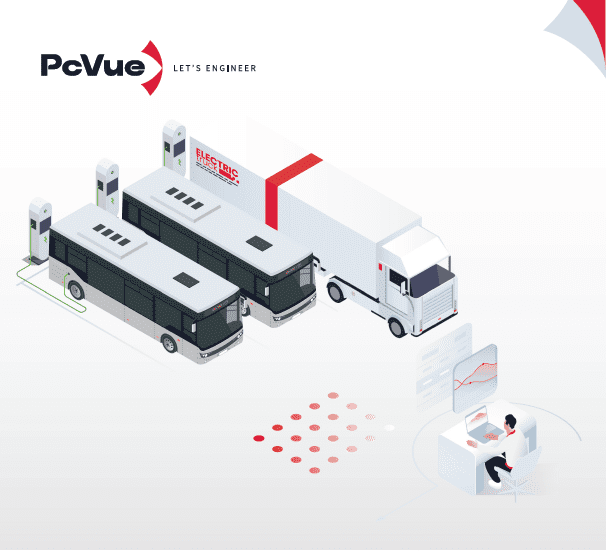
As public transport agencies and logistics companies accelerate their shift to electric vehicles, a critical challenge emerges that few anticipated: managing the energy ecosystem of an entire depot. The problem isn’t just about charging buses or delivery vans—it’s about orchestrating an entire facility where every kilowatt matters.
Too many organizations make the same mistake. They approach electrification like a checklist:
- – Acquire vehicles and install charging stations.
- – Add a Charging Station Management System (CSMS) and connect it to the Depot Management System (DMS)
- – Keep the existing Building Management System (BMS)
- – Monitor energy separately
This siloed methodology creates operational inefficiencies where systems lack interoperability, operators navigate multiple disconnected interfaces, and optimization opportunities remain unrealized. More critically, these technical limitations cascade into service delivery issues: delayed departures, inconsistent charging availability, and operational unpredictability precisely the scenarios that concern Departments of Transportation (DOT) and undermine public confidence in transit electrification.
The Hidden Complexity of Electric Depot Infrastructure
The operational reality of electric depot management reveals a fundamental challenge: EV charging stations function as integral components of a larger energy infrastructure. Modern depot facilities encompass HVAC systems, warehouse lighting, refrigeration units, administrative buildings, and potentially manufacturing equipment—all drawing power from shared electrical service infrastructure.
For fleet operators managing overnight charging cycles for dozens of buses or continuous charging operations for delivery fleets, the critical question evolves beyond charging capacity. Transit agencies operating electric bus fleets require specialized CSMS-SCADA solutions for e-bus depot infrastructure to address the unique challenges of high-power charging coordination. The fundamental concern becomes: can the facility’s electrical infrastructure support peak charging loads without triggering demand charges or compromising power quality?
This scenario exposes the limitations of traditional software architectures. CSMS platforms provide charging infrastructure visibility but lack insight into building-level electrical loads. BMS platforms manage HVAC and lighting systems but cannot prioritize or coordinate EV charging requirements. Energy monitoring systems track consumption patterns but lack active management capabilities.
These platforms were architected independently, and their technical designs fundamentally preclude seamless integration especially when integration is needed to the DMS (Depot Management System), CMMS (Computerized Maintenance Management System) or even enterprise applications (such as data lakes or dashboard applications) are taken into account.

Why Unified Platforms Outperform Fragmented Systems
The solution involves adopting a unified CSMS-SCADA platform that consolidates multiple functions rather than managing fragmented point solutions. While integration points remain necessary connecting to chargers (OCPP), vehicles (MQTT), depot planning systems (VDV 463), and other subsystems, a comprehensive platform reduces integration complexity by providing native protocol support and centralized orchestration. Forward-thinking fleet operators are discovering that these unified platforms deliver measurable advantages over fragmented architectures.
Operational Efficiency That Actually Matters
Consider the daily reality for a depot operations manager. In a fragmented system, checking the status of your charging infrastructure means logging into one platform. Adjusting building climate control requires a different interface. Reviewing energy consumption pulls you into yet another dashboard.
A unified system changes this completely. One interface, one training session, one mental model for how everything works. When an alert triggers—whether it’s a charger malfunction or unusual building consumption—operators see it in context. They can immediately understand if a building issue is affecting charging, or if charging demand is stressing building systems.
This isn’t just convenience. It’s the difference between reactive troubleshooting and proactive management. Studies show that integrated building and energy systems reduce response times to issues by 40-60%, simply because operators can see the full picture.
Real Cost Reduction Through Resource Pooling
Let’s talk about what unification actually saves. In a typical fragmented deployment, you’re paying for:
- – Multiple server instances (physical or cloud)
- – Separate licensing fees for each platform
- – Individual maintenance contracts
- – Redundant data storage and backup systems
- – Multiple vendor support relationships
More significantly, you’re paying for the integration work—either building custom APIs to connect systems, or accepting that they simply won’t communicate.
A unified approach eliminates this redundancy. One platform means one set of infrastructure costs, one support relationship, one upgrade cycle. For a medium-sized transit agency or logistics operation, this can represent hundreds of thousands in avoided costs over a five-year deployment.
Greenfield vs. Brownfield Deployments: For new depot facilities (greenfield projects), this unified approach delivers maximum value from day one. For existing operations with established BMS or energy management systems, the strategy adapts: deploy the unified platform to integrate with current BMS/EMS systems, creating a central repository where all relevant data charging, energy, and building systems is acquired and displayed to operators. This approach achieves the consolidation benefits while respecting existing infrastructure investments.
The Smart Charging Capability You’re Missing
Here’s where unified platforms become truly transformative: intelligent energy orchestration. When your system has real-time visibility into both facility loads and charging demand, it can make smart decisions that fragmented systems simply cannot. Consider the operational reality: for larger fleets, depot charging loads often 150kW or more per charger dwarf typical building loads like HVAC or lighting.
Most facilities require electrical infrastructure upgrades to support multiple high-power chargers. However, intelligent load management becomes critical even with upgraded infrastructure. During off-peak hours (for example, 11 PM when operational activities decrease and electricity pricing drops), the unified platform optimizes charging schedules across the entire fleet.
By coordinating charging cycles with grid conditions, depot schedules, vehicle readiness requirements, and available electrical capacity, the system maximizes operational efficiency while managing peak demand exposure.
This operational intelligence delivers measurable benefits. Facilities with unified energy management can significantly increase their effective charging throughput through intelligent scheduling and load coordination—optimizing the use of available electrical capacity whether from existing infrastructure or necessary upgrades. Smart building and energy management platforms enable this level of optimization by providing comprehensive visibility across all facility systems r tracking and analyzing consumption to detect drifts and drive energy ROI.
The Multi-Protocol Reality: Why Most Systems Fail Here
The technical challenge that exposes most “unified” platforms as inadequate is protocol support. Energy meters may use Modbus RTU or DNP3. Critically, substation and energy distribution systems communicate via IEC 61850 and DNP3 protocols essential for managing the electrical infrastructure that powers both charging operations and facility systems.
Most platforms claiming to be “comprehensive” actually just speak one language well and hack together basic support for others through third-party gateways or limited integrations. The result is partial visibility, delayed data, and functionality that breaks when protocols update.
True platform unification requires native, robust support across these protocol families. The platform needs to be equally fluent whether it’s communicating with an OCPP 2.0.1 DC fast charger, a BACnet/IP building controller, a legacy Modbus device on an RS-485 network, or vehicle telemetry systems using MQTT and other real-time data protocols for vehicle state monitoring and diagnostics.
This is where SCADA platforms have a distinct advantage. Built for industrial environments where multi-protocol communication is the norm rather than the exception, these systems are engineered to bridge different technological worlds without relying on fragile middleware. Modern HMI/SCADA platforms designed for building management provide the foundation for truly unified operations.
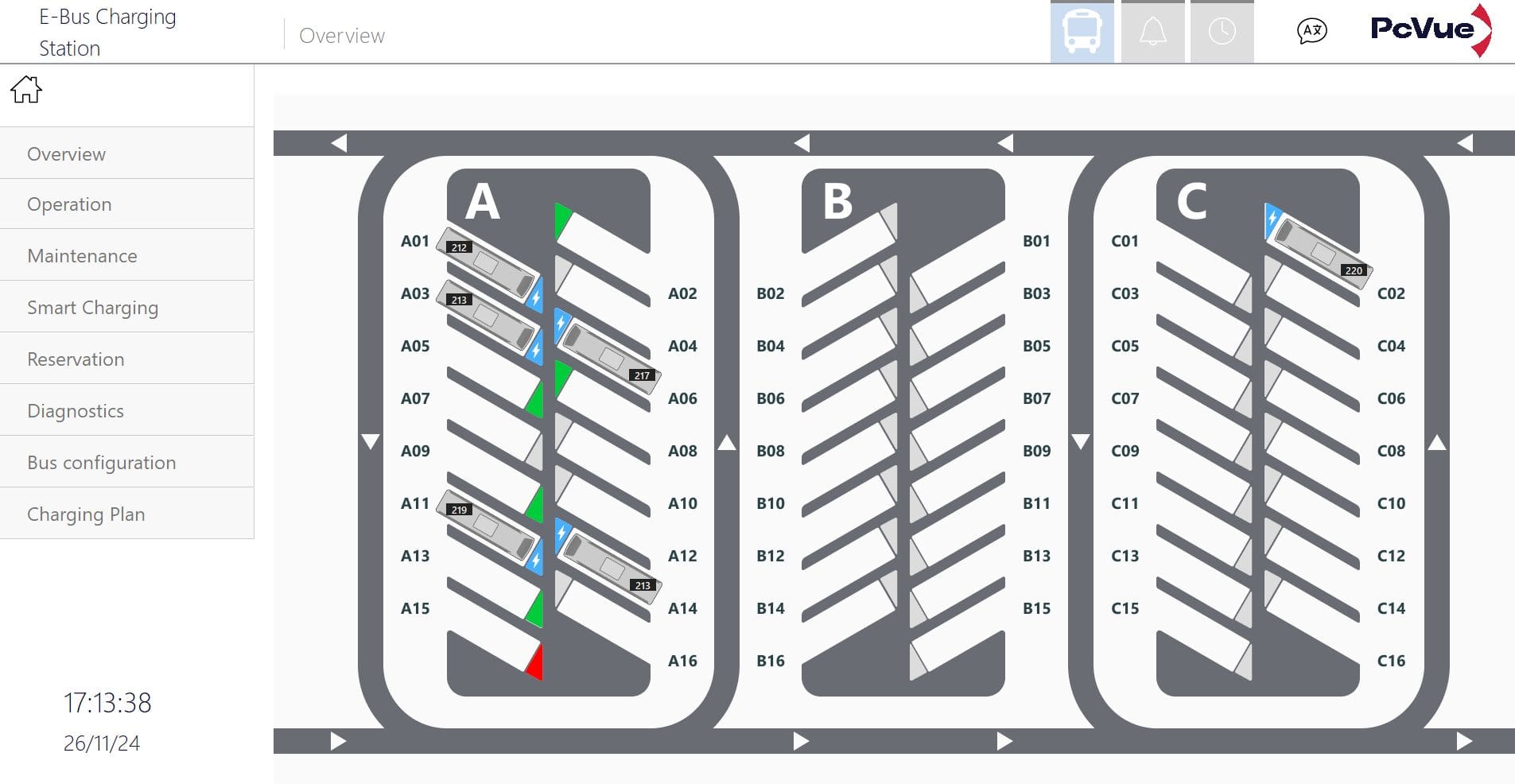
The PcVue Difference: Open Architecture for Complex Operations
Among the platforms designed for this level of integration, PcVue stands out by refusing to compromise on interoperability. Rather than forcing operators to choose between charging management, building automation, and energy management, it provides complete native support across all three domains—recognizing that energy management (power distribution, grid integration, substation monitoring) requires distinct capabilities from building management (HVAC, fire control, environmental systems).
PcVue’s OCPP implementation allows direct communication with charging stations from multiple manufacturers, supporting both OCPP 1.6 and the newer 2.0.1 specification. This isn’t a bolt-on feature—it’s integrated into the same engine that handles BACnet building controllers, Modbus industrial equipment, and the dozens of other protocols modern facilities depend on.
What does this mean practically? A transit agency can monitor and control their entire depot ecosystem from a single platform. When a charger reports an error via OCPP, the same system can check if building power quality issues contributed to the fault. When planning overnight charging schedules, the platform considers forecasted building loads, grid pricing signals, and vehicle charging priorities simultaneously.
This architecture also positions facilities for future technologies that fragmented systems struggle to accommodate. Vehicle-to-Grid (V2G) capabilities, behind-the-meter battery storage, on-site solar generation, and grid demand response programs all integrate into the same unified control framework.
Future-Proofing Your Investement
The electric vehicle market is evolving rapidly, but the underlying need for comprehensive facility management isn’t going away. If anything, it’s intensifying as:
- – Vehicle batteries get larger and charging speeds increase
- – Facilities add renewable generation and stationary storage
- – Grid operators offer more complex pricing and demand response programs
- – Regulations require more detailed reporting on energy use and sustainability metrics
Betting on a single-purpose charging management system means you’ll be back shopping for new platforms as each of these capabilities becomes necessary. Choosing fragmented systems from different vendors means you’ll be forever managing integrations that break with every update.
An open, unified platform approach means your initial investment grows with your needs. The same system managing today’s depot charging becomes tomorrow’s microgrid orchestrator, integrating solar, storage, and V2G without requiring a technology replacement cycle. Transportation infrastructure solutions designed with this evolution in mind provide the scalability and flexibility modern fleets require.
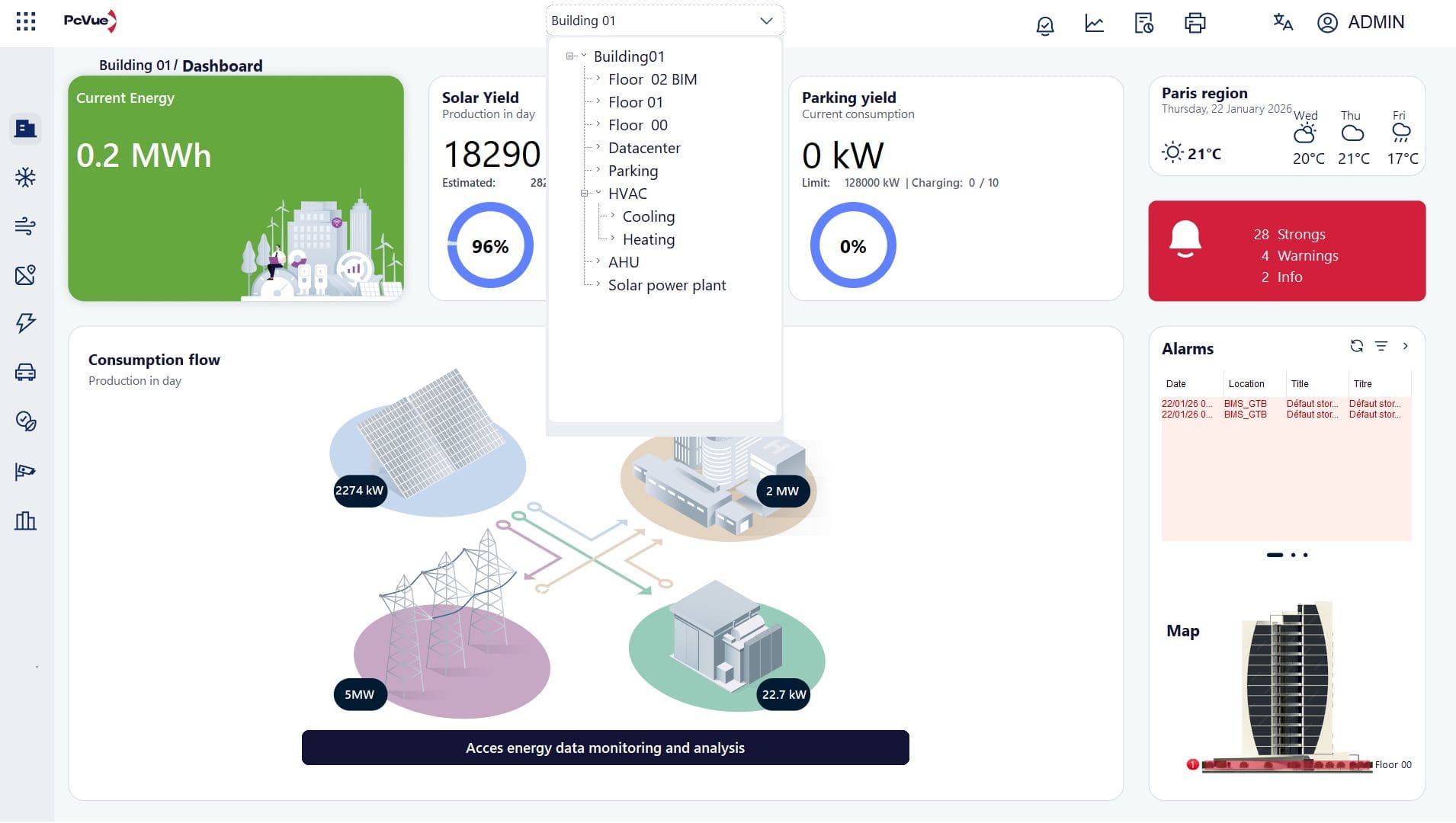
What to look for in a Unified Fleet Management Platform
If you’re evaluating platforms for your electric fleet operation, here are the critical questions to ask:
Does it speak the languages that matter? Look for native OCPP support (not through a gateway), robust BACnet implementation, and genuine multi-protocol capability. If the vendor can’t clearly explain their protocol architecture, that’s a red flag.
Can it scale without architectural changes? You might start with 20 charging points, but what happens at 200? What about adding solar arrays or battery storage? The platform should handle growth through configuration, not custom development.
Who owns the data? Some platforms lock you into proprietary data formats or require ongoing cloud fees to access your own operational data. Look for systems that treat your data as yours, with standard export formats and local storage options. Systems must also offer on-premises installation options, not only cloud-based deployments. Additionally, evaluate native integration capabilities with enterprise systems (Azure, Kafka Avro) to facilitate seamless data flow to organizational data lakes and analytics platforms—ensuring your operational data supports broader business intelligence and decision-making processes.
What’s the vendor’s track record? Charging infrastructure is relatively new, but building automation and industrial control aren’t. Vendors with decades of SCADA and BMS experience bring more to the table than companies focused solely on EV charging.
Is the learning curve realistic? “Unified” shouldn’t mean “overwhelmingly complex.” The best platforms expose advanced capabilities to power users while keeping common operations straightforward for day-to-day operators.
Making the Transition from Fragmented to Unified
Organizations planning new electric fleet deployments should prioritize unified platforms from the outset to avoid the fragmentation challenges described throughout this article. However, for operations already committed to separate CSMS and BMS platforms, the decision to transition depends on specific factors: Are recurring annual license fees substantial enough that migration costs could be recovered within 1-2 years?
Do current systems create operational pain points—limited scalability, poor integration capabilities, vendor lock-in, or inadequate analytics? Is the organization facing significant system upgrades or replacements that create natural transition opportunities? If these conditions apply, a phased migration approach makes sense: establish the unified platform alongside existing systems, perhaps managing a subset of chargers or a pilot facility. This allows operators to validate capabilities, measure ROI, and build operational confidence without disrupting service.
As the business case strengthens through demonstrated cost savings and operational improvements, expand the unified platform’s scope while retiring legacy systems. The key consideration isn’t sunk cost it’s total cost of ownership. If fragmented systems limit operational efficiency, prevent energy optimization, and impose high recurring fees, the investment required for transition often pays back rapidly through consolidated licensing, reduced integration maintenance, and improved operational performance.
The Bottom Line: Integration as Competitive Advantage
Electric fleet operations are complex enough without self-inflicted wounds from fragmented software architectures. As the industry matures, the gap between operators using unified platforms and those juggling software silos will only widen.
The facilities with comprehensive visibility, intelligent energy orchestration, and adaptive control will optimize their operations in ways fragmented systems simply cannot match. They’ll charge more vehicles from the same electrical service, avoid costly demand charges, integrate renewable energy effectively, and respond to grid signals that provide new revenue opportunities.
Most importantly, they’ll be ready for whatever comes next—whether that’s V2G, megawatt charging, or grid services we haven’t imagined yet.
The question isn’t whether to unify your fleet management platform. It’s whether you can afford not to.
From Fragmentation to Orchestration
The electric vehicle revolution demands more than just charging infrastructure—it requires a fundamental rethinking of how we manage energy across entire facilities. The software silo approach, where separate systems handle charging, building automation, and energy monitoring, creates artificial barriers that limit operational efficiency and waste valuable resources.
By placing anticipation at the heart of their energy strategy, organizations are transforming a cost constraint into a lever for sustainable performance. This transformation requires a clear vision of operational challenges, an appropriate technical architecture, and effective energy data governance.
- – Anticipating vehicle charging times
- – Anticipating peak consumption at the depot
- – Anticipating charging speeds based on battery SoH (State of Health)
- – Anticipating risks/battery temperature runaway
For fleet operators and facility managers evaluating their technology roadmap, the path forward is clear. Invest in platforms that offer genuine multi-protocol support, proven scalability, and open architectures. Look beyond single-purpose charging management systems to comprehensive orchestration platforms that can evolve with your needs.
The electric fleet future belongs to organizations that recognize infrastructure complexity and address it with unified, intelligent systems. The question facing every fleet operator today isn’t whether integration matters it’s how quickly you can achieve it.