How MQTT Enhances Modern SCADA Architectures with PcVue

Industrial architecture has changed. Energy systems are distributed, infrastructure spans cities and countries, and integrators are no longer deploying single-site supervision systems — they are designing multi-site, bandwidth-constrained, and hybrid IT/OT architectures. In this context, MQTT has become a key enabler. But MQTT is not just a communication protocol. When integrated into PcVue, it becomes a powerful tool for scalable, secure, and efficient supervision.
What Is MQTT and How Does It Work?
MQTT (Message Queuing Telemetry Transport) was originally specified by an OASIS technical committee and is now standardized as ISO/IEC 20922, making it an internationally recognized protocol for IoT and industrial communication. It is built on a publish/subscribe model: clients connect to a broker, publish messages to topics, and subscribe to topics of interest. The broker acts purely as a message relay, and the message payload itself is defined by the publisher. Unlike traditional SCADA polling models, devices do not wait to be queried — they publish data when it changes, and systems subscribe only to the data they need. This makes MQTT efficient, scalable, ideal for remote or cellular-connected sites, and well-suited to cloud and hybrid architectures. MQTT operates through brokers such as Eclipse Mosquitto or HiveMQ, which manage message distribution between devices and applications.
PcVue as Publisher, Subscriber, and Integration Layer
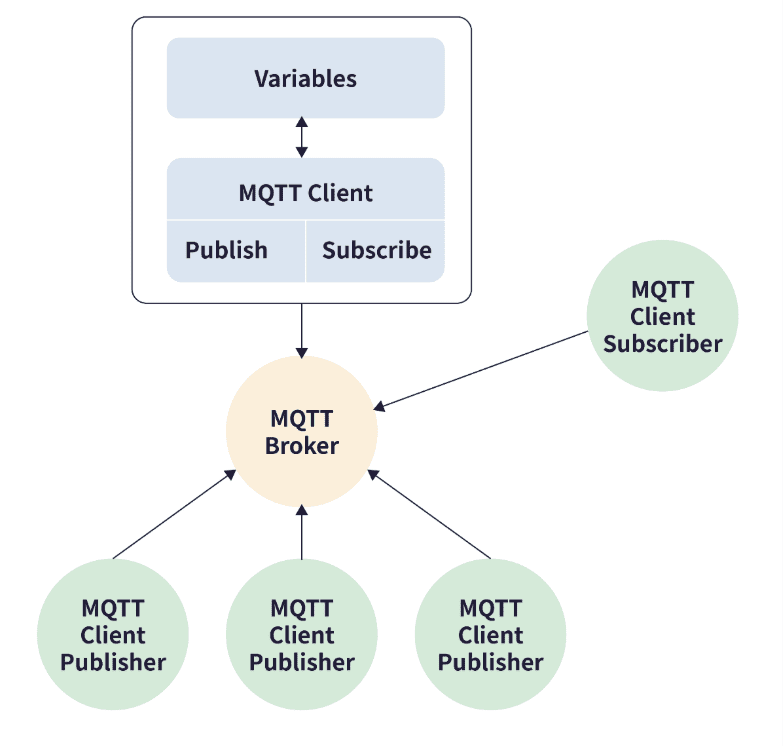
Within an MQTT architecture comprising one or more brokers, PcVue can operate as a pure subscriber, a pure publisher, or both simultaneously. As a pure subscriber, it filters payload content, extracts variable values, and optionally retrieves timestamps and quality indicators. As a pure publisher, it transmits variable values with fully configurable payloads, optionally including timestamps, quality, and additional attributes. In combined mode, PcVue updates variables based on incoming messages while republishing normalized and standardized payloads, effectively acting as a data concentrator or information gateway.
This flexibility allows PcVue to serve not only as a supervision system, but also as an integration layer within distributed infrastructures. Configuration is handled through a dedicated .ini file and standard PcVue configuration mechanisms, ensuring consistency with existing engineering workflows. During development and testing phases, tools such as MQTT Explorer are particularly useful for inspecting topic structures, validating payloads, and troubleshooting message flows before going live.
For detailed configuration guidance, refer to the official PcVue documentation:
https://www.pcvue.com/ProductHelp/PcVue/en/Content/Extras/mqtt_overview.php
Where MQTT Fits in a PcVue Architecture
Typical Architecture
Field Devices → Edge Gateway → MQTT Broker → PcVue → Operators / Historian / Alarms
- A remote device publishes data (e.g., temperature, energy consumption).
- The MQTT broker stores the published message.
- PcVue subscribes to relevant topics, and the broker dispatches the available messages.
- PcVue processes the data for:
- Visualization
- Alarm management
- Historical logging
- KPI dashboards
Instead of constant polling, communication becomes event driven.
In a modern PcVue deployment, MQTT typically sits between edge devices and the supervision layer. A remote device publishes data — temperature, energy consumption, status — to an edge gateway, which forwards it to an MQTT broker. PcVue subscribes to relevant topics, and the broker dispatches available messages for processing across visualization, alarm management, historical logging, and KPI dashboards. Instead of constant polling, communication becomes event-driven. For integrators, this means lower bandwidth usage, reduced infrastructure load, and better performance across distributed sites.
Why Integrators Are Moving to MQTT
This architectural shift carries significant practical advantages. Energy networks, water systems, and smart buildings are increasingly distributed across wide geographies. MQTT allows lightweight communication over VPN or cellular with secure TLS-encrypted connections and simplified firewall traversal, making PcVue ideal for managing geographically dispersed assets. Traditional polling generates constant traffic even when no values change, whereas MQTT transmits only when necessary.
For remote installations such as solar farms, substations, and water pumping stations, this directly reduces operational costs. Many integrators now also deploy hybrid architectures combining edge intelligence on-site, central supervision, and cloud analytics — and MQTT acts as a bridge between OT and IT layers, allowing PcVue to integrate seamlessly. Adding new devices no longer requires reconfiguring polling structures; PcVue subscribes dynamically, simplifying expansion and futureproofing.
How PcVue Compares to Other MQTT SCADA Platforms
| Traditional SCADA | MQTT with PcVue |
| Master polls devices | Devices publish events |
| Constant communication | Event-driven |
| Higher bandwidth use | Optimized traffic |
| Less flexible scaling | Highly scalable |
For integrators, this is not just a technical upgrade — it is an architectural revolution.
Many integrators evaluating MQTT platforms search for comparisons with solutions such as Ignition SCADA, Rapid SCADA, Citect SCADA, Mango SCADA, Eclipse SCADA, or free SCADA MQTT implementations. PcVue differentiates itself through native multi-protocol interoperability — including MQTT, OPC UA, Modbus, and SNMP — scalable architectures from single station to fully distributed systems, built-in alarm and event management, advanced visualization and reporting, and alignment with IEC 62443 industrial cybersecurity requirements.
Find out more about our platform: HMI SCADA | PcVue
Unlike free or lightweight implementations, PcVue is designed for long-term industrial deployment, scalability, and compliance. For critical infrastructure such as data centers, it additionally supports high availability, PUE performance indicators, and full regulatory alignment.
Real-World Use Cases and Security Considerations

Real-world applications illustrate the breadth of this approach. In renewable energy, solar and wind sites publish production and status data to a central broker, and PcVue supervises the entire portfolio. In smart buildings, HVAC controllers publish operational data for alarm management, energy dashboards, and occupancy optimization. In water and wastewater, remote pumping stations send level and status data over cellular networks to PcVue via MQTT. In data centers managing electrical, cooling, and security systems across distributed infrastructure, MQTT enables secure data aggregation into a unified supervision platform.
Electric vehicle charging networks, which require remote supervision across multiple geographically dispersed stations, similarly benefit from MQTT’s scalability and PcVue’s native interoperability and support for compliant deployment. On the security front, MQTT supports TLS encryption, authentication mechanisms, and topic-level access control. Within a properly segmented architecture, and when integrated with PcVue’s cybersecurity capabilities aligned with IEC 62443, MQTT supports secure, industrial-grade deployments.
Conclusion
MQTT alone is a protocol. Integrated into PcVue, it becomes a strategic component of modern SCADA design and a core enabler for integrators building distributed energy systems, smart infrastructure, data centers, EV charging platforms, and hybrid cloud architectures — ensuring efficiency, scalability, and resilience while PcVue maintains full supervision, visualization, and operational control. The broader transition toward distributed energy systems, edge intelligence, hybrid cloud architectures, and multi-site supervision makes MQTT SCADA architectures not just relevant, but essential.
Find out more: MQTT – The Standard for IoT Messaging