Overview of IEC 60870-5
IEC 60870-5 is a communication standard designed for telecontrol in the power generation and distribution systems. PcVue operates has a client (master) and the field devices are servers (slaves). Both polling and unsolicited data exchange are supported. In practice, a general interrogation is used at startup to collect the initial state of servers, and then a mix of polling and unsollicited data exchanges are used to refresh data.
The IEC 60870-5 driver in PcVue supports the IEC 60870-5-104 protocol, designed to operate over TCP/IP.
It also supports a variant of the IEC 60870-5-101 protocol (originally defined to operate over serial transmission channels) that operates in unbalanced mode over TCP or UDP. While this flavor of the IEC 101 over IP does not correspond to the original standard, it is used nowadays in a variety of systems where legacy IEC 101 devices are accessed through serial-to-IP gateways.
- An IEC 60870-5 network has Devices,
- A device is comprised of one or more Sectors,
- A Sector hosts and exposes a predefined set of Information Objects.
- Support for Devices compliant with either the IEC 60870-5-101 (via a serial-IP gateway) or the IEC 60870-5-104 standard.
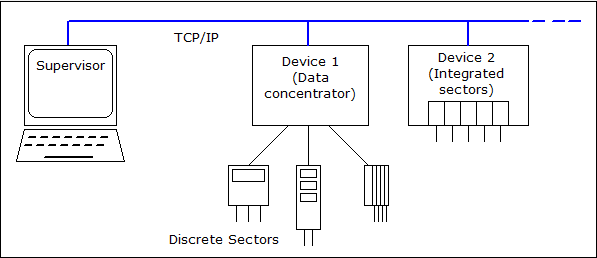
- A Device can either be a data concentrator, collecting together several discrete Sectors, or it can have integrated Sectors. Often a Device will only have one Sector making the Device and Sector synonymous. Each Device is identified on the network by its IP address.
- A Sector is typically a piece of control equipment with one or more Information Objects - for example a circuit breaker.
- Information Objects represent the physical inputs and outputs. The types of Information Object that are available is as defined by the IEC 60870-5 standard. Each type has a corresponding ASDU (Application Service Data Unit) which defines the structure, type and format of messages.
The IEC 60870-5 configuration is accessed from the Application Explorer - Communication.Data acquisition.IEC 60870-5.