
The Paradox of ”Mute” Data
The global energy landscape and evolving regulatory frameworks are forcing organizations to increase the maturity of their management systems.
Rising energy costs make every inefficiency visible on the bottom line. Simultaneously, international standards and directives—such as the EU’s EPBD (Energy Performance of Buildings Directive) and the ISO 50001 framework—now demand active supervision and regulation of technical systems rather than passive tracking.
Rather than viewing these regulations as a constraint, forward-thinking leaders see an opportunity. Investing in a scalable, open architecture allows you not only to meet compliance requirements but also to secure long-term operational performance. In today’s market, there is no room for approximation. Businesses face a “scissor effect”:
- Skyrocketing Operational Costs: Every kWh wasted due to poorly regulated equipment or undetected drift impacts profitability directly.
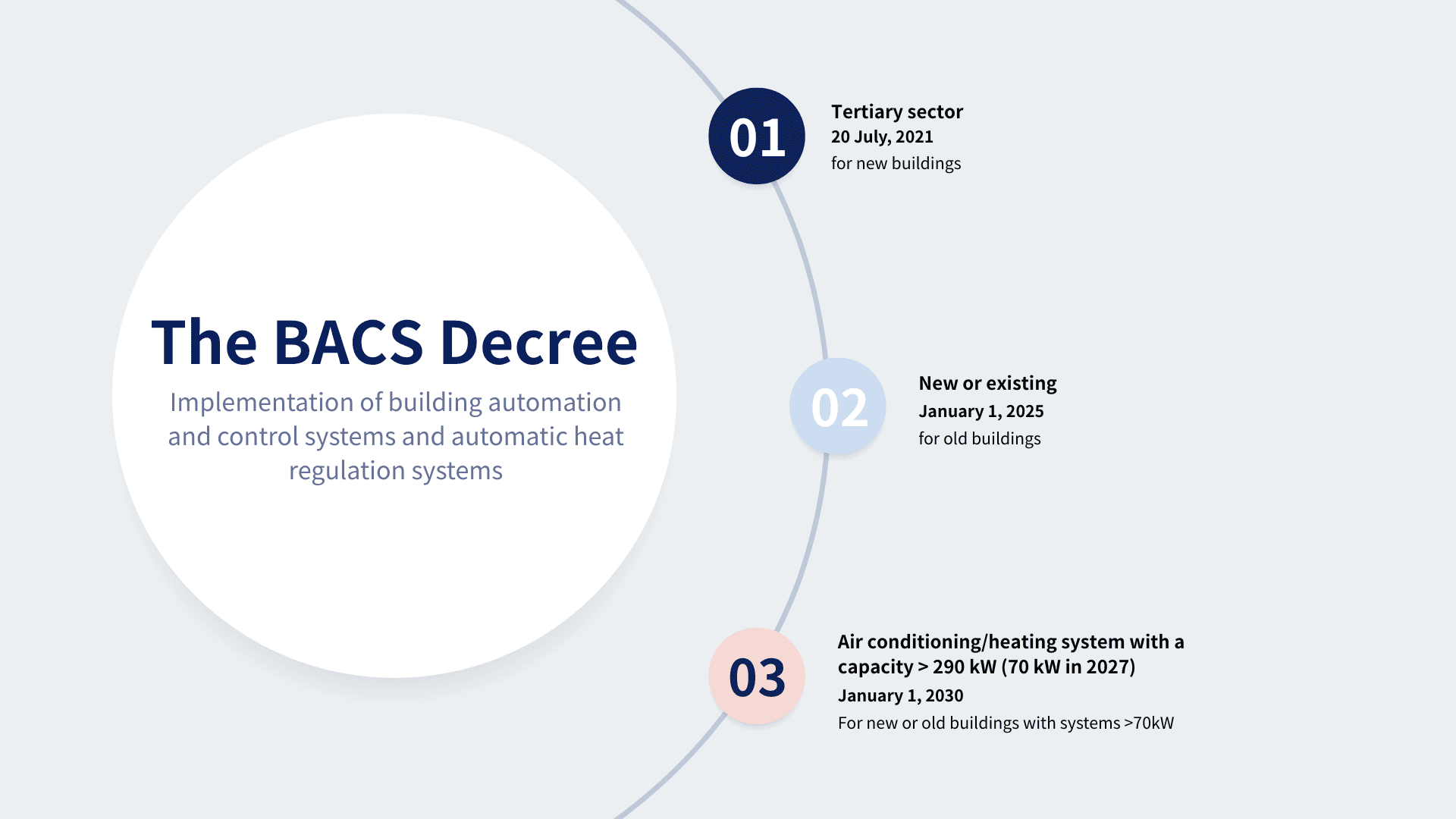
The Regulatory Framework: In Europe and specifically in France, regulatory obligations—particularly the BACS decree—now mandate not only monitoring but active control and regulation of building energy consumption. Simple ‘surveillance’ is no longer enough for compliance; it requires real-time optimization and automated control capabilities.

Turning Regulatory Compliance into Investment Opportunities
The global energy landscape and evolving regulatory frameworks are forcing organizations to increase the maturity of their management systems.
Rising energy costs make every inefficiency visible on the bottom line. Simultaneously, international standards and directives—such as the EU’s EPBD (Energy Performance of Buildings Directive) and the ISO 50001 framework—now demand active supervision and regulation of technical systems rather than passive tracking.
Rather than viewing these regulations as a constraint, forward-thinking leaders see an opportunity. Investing in a scalable, open architecture allows you not only to meet compliance requirements but also to secure long-term operational performance. In today’s market, there is no room for approximation. Businesses face a “scissor effect”:
- Skyrocketing Operational Costs: Every kWh wasted due to poorly regulated equipment or undetected drift impacts profitability directly.
- The Regulatory Framework: In Europe and specifically in France, regulatory obligations—particularly the BACS decree—now mandate not only monitoring but active control and regulation of building energy consumption. Simple ‘surveillance’ is no longer enough for compliance; it requires real-time optimization and automated control capabilities.
The Blind Spots of Traditional Monitoring
Most legacy systems suffer from three critical limitations:
- The Reactivity Trap: Analyzing a consumption peak at the end of the month (or even the next day) means acknowledging a financial loss that has already occurred. Traditional monitoring is a rearview mirror, not a radar.
- Fragmentation and Silos: Energy data is often disconnected from operational data (production schedules, occupancy rates, weather forecasts). Without this correlation, it is impossible to identify the root cause of overconsumption.
The “Frozen System” Problem: Many aging installations cannot communicate with modern IoT sensors or renewable energy sources, making global optimization impossible. e.
Impact on Teams: Bottlenecked Operational Performance
A lack of intelligent tools places a heavy burden on field teams:
- Decision Fatigue: Faced with incessant alarms and floods of raw data, operators struggle to prioritize corrective actions.
- Lack of Coordination: Without a central “Hub,” maintenance, energy management, and operations departments work in silos, often leading to contradictory decisions.
- The Cost of Maintenance: Now, moving toward Performance-Based Maintenance. Without a granular analysis of equipment behavior, teams remain stuck in costly preventive or reactive cycles, rather than optimizing based on actual operating conditions and real-time performance.

The Invisible Foundation: Cybersecurity as a Guarantee of Longevity
Efficient energy optimization is worthless if it compromises your infrastructure. In 2026, opening networks to collect IoT data and exchange information with the wider ecosystem creates new attack surfaces.
This is where the robustness of your SCADA platform becomes critical. A modern system must be Secure by Design. Adopting international standards like IEC 62443 is now a prerequisite.
What does this guarantee? This certification confirms that the software development lifecycle follows extremely rigorous security processes. For the end-user, this ensures your installation is not a “frozen system.” You can evolve your energy management, add new connectors, and update assets without compromising business continuity or data sovereignty. It is the guarantee of a sustainable investment, capable of meeting the requirements of directives such as NIS2 and the Cyber Resilience Act (CRA).

Redefining Optimization: Moving Toward Intelligent Control
Moving from simple data display to genuine optimization requires a system capable of:
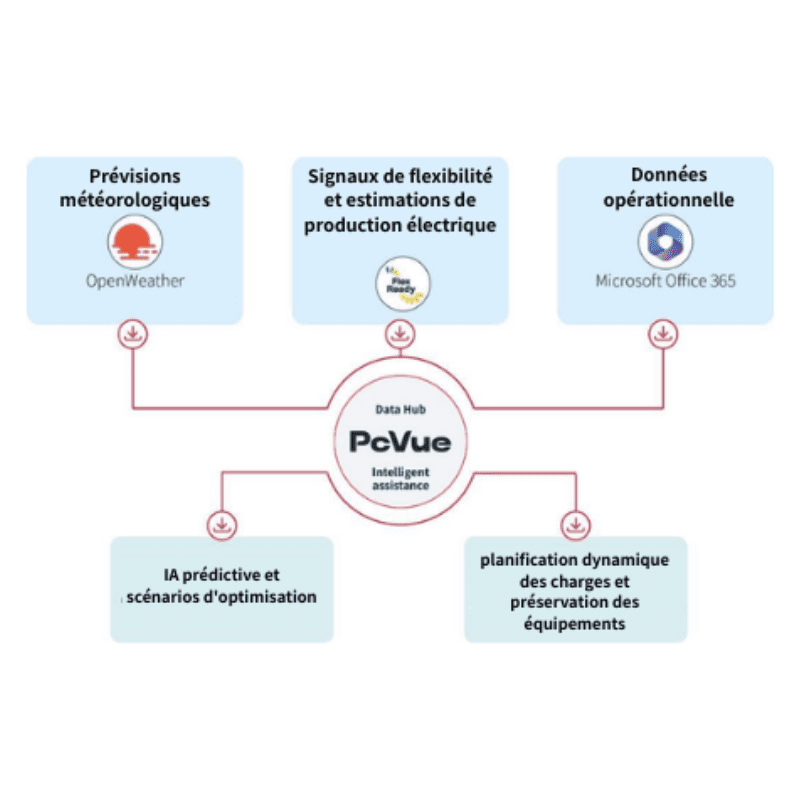
- Anticipating: Analyzing historical data and crossing it with external variables (weather, energy market prices) to provide predictive insights.
- Recommending: Providing optimization scenarios based on data analysis. While technology provides the recommendation, the human remains the final decision-maker.
- Unifying: Centralizing data from Energy, BMS (Building Management Systems), Industrial Processes, and IoT into a single, transversal truth.
Conclusion: Don’t Be a Spectator of Your Data
The challenge in 2026 is no longer just to watch, but to enrich and correlate. Structuring, contextualizing, and analyzing data transforms a mere observation into an enlightened action.
The market is moving toward “Flex-Ready” systems—flexible architectures capable of bridging the gap between energy producers, distributors, and consumers. The future of your facility depends on its ability to leverage every data point through intelligent, secure, and open management.
To take your energy strategy further, explore how our dedicated solutions can bridge the gap between compliance and performance:
EmVue: Energy monitoring and analysis: A dedicated solution to centralize data, detect drifts, and drive energy performance through in-depth consumption analysis.