In the era of Industry 4.0, the goal for any forward-thinking manufacturer is to achieve end-to-end production visibility. To reach this state, organizations must move beyond isolated departmental data and embrace a holistic approach to manufacturing IT/OT integration. This transformation is centered on the technical and operational synergy known as MES–SCADA integration. By bridging the gap between supervisory control and high-level enterprise planning, companies can transform their factory floors into responsive, data-driven ecosystems.
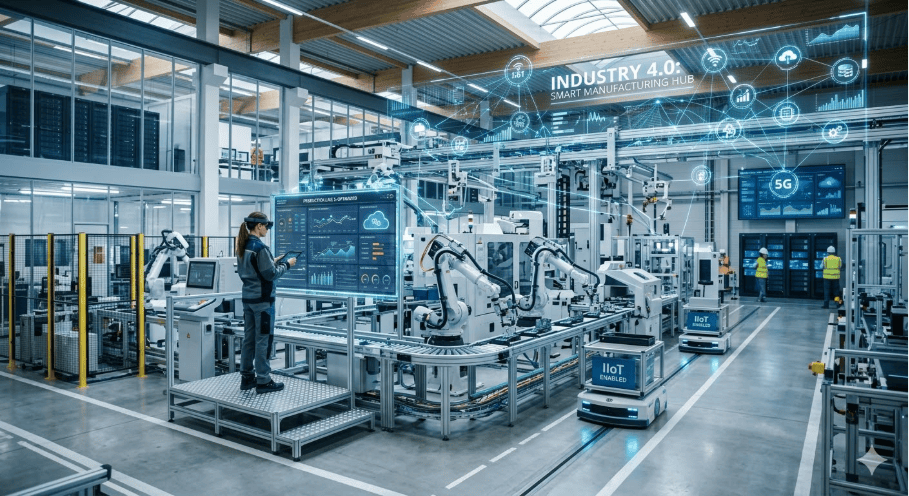
The following article explores the essential components, technical requirements, and strategic best practices for achieving seamless shop floor integration, with a specific focus on SAP integration with MES and the real-world success of industry leaders like Dunn-Edwards Paint.
Defining the Foundation: The 11 Features of an MES
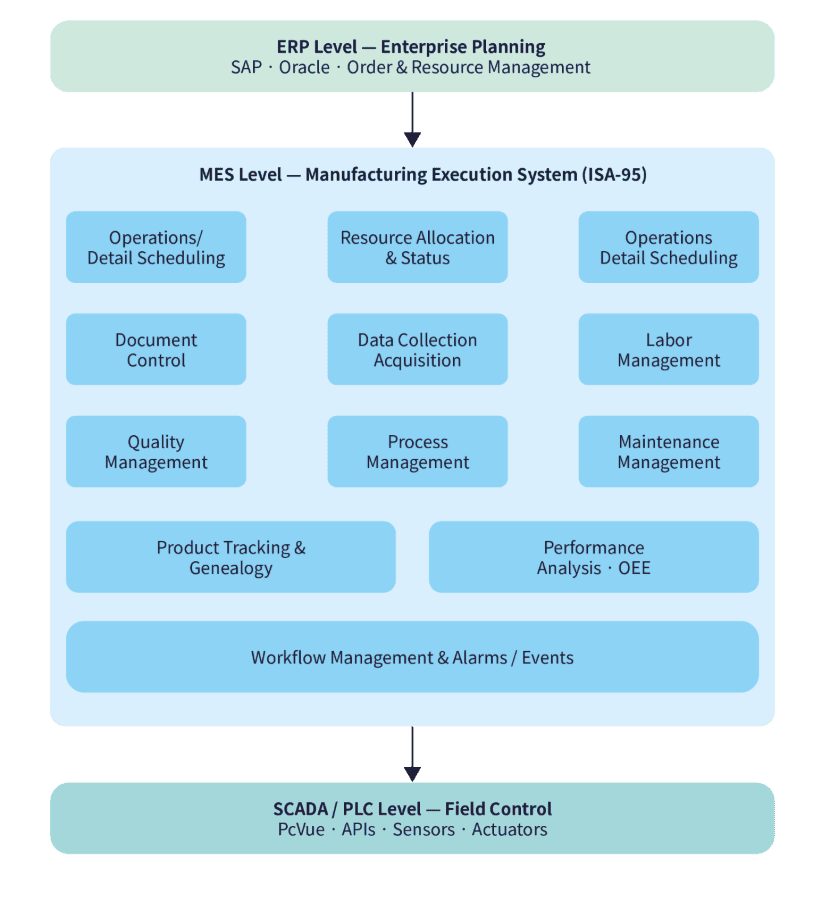
To understand the value of industrial system integration, one must first define the role of the Manufacturing Execution System (MES). While SCADA focuses on the “how” of a machine—handling real-time process control—the MES manages the “what, when, and who.” For true MES and SCADA interoperability, an MES typically fulfills 11 core functions:
- Operations/Detail Scheduling: Sequencing work based on actual resource capacity.
- Resource Allocation and Status: Managing the live state of machines, tools, and labor.
- Dispatching Production Units: Controlling the flow of work orders to specific workstations.
- Document Control: Providing digital versions of work instructions and recipes, ensuring operators always use the most current specifications.
- Data Collection/Acquisition: The engine for SCADA to MES data integration, gathering real-time telemetry from the floor.
- Labor Management: Tracking staff qualifications and time spent on specific tasks to optimize workforce efficiency.
- Quality Management: Monitoring deviations in real-time to ensure every product meets compliance standards — a task reinforced by SPC (Statistical Process Control) control charts, which flag process drift before it produces non-conforming parts.
- Process Management: Providing intelligent decision support to operators to prevent failures before they occur.
- Maintenance Management: Coordinating repairs to maximize equipment uptime.
- Product Tracking and Genealogy: Creating a digital “birth certificate” for every batch, detailing every ingredient and process step. This is often enhanced by RFID and BLE technologies to track raw materials as they move through zones.
- Performance Analysis: Calculating critical KPIs like OEE (Overall Equipment Effectiveness) to provide a macro view of plant health
Industrial System Integration at Dunn-Edwards
The consolidation of Dunn-Edwards Paint’s operations into their Phoenix facility is a landmark case study for industrial system integration. Previously, they operated a manual plant in Tempe and a semi-automated one in Los Angeles. The risks were high: manual paint manufacturing often leads to inconsistencies in drying times, coverage, and color accuracy.
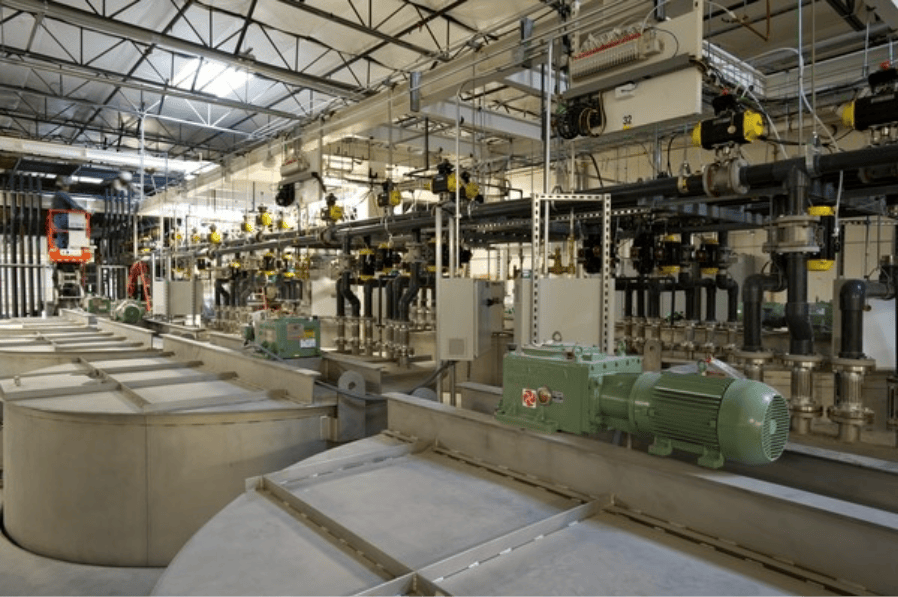
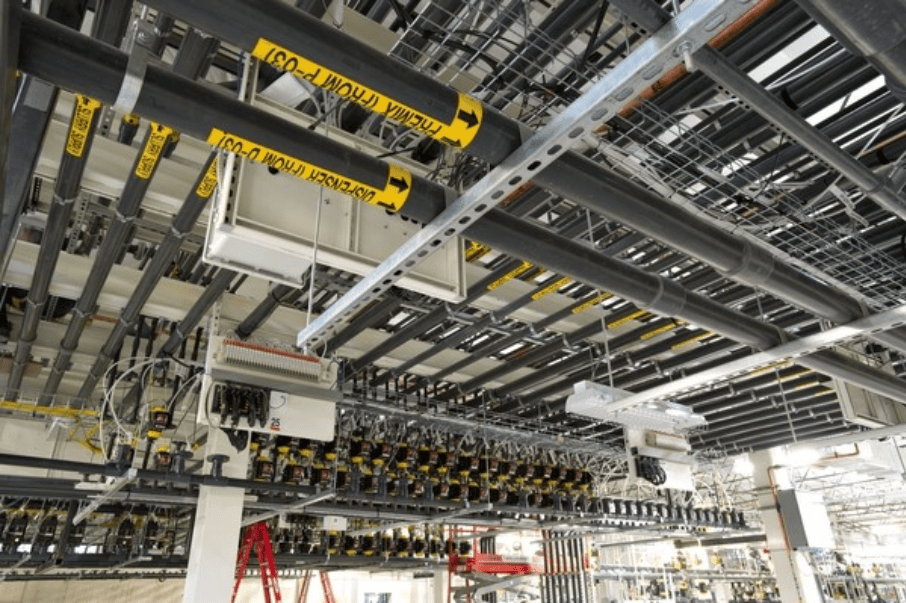
By commissioning a state-of-the-art facility that linked their PcVue SCADA system with an SAP ERP, they mitigated these risks. The ERP–MES connectivity at Dunn-Edwards is built on massive SAP data exchange (IDoc, BAPI):
- The Scale: The system manages 75,000 data points, with 55,000 shared directly with SAP.
- The Connection: SAP utilizes an embedded Pico module for I/O connectivity, communicating with the SCADA layer via the OPC standard.
- Production Order Integration: When a sales order is created in SAP, it is pushed down to the plant floor. Operators now manage 10–20 batches per shift with complete visibility, a massive increase in manual capabilities.
The “ERP Giant” Debate: SAP S/4HANA Integration
As companies move toward SAP S/4HANA integration, there is a common misconception that the ERP can handle everything. This is a challenge that system integrators like Centris Inc. — specialists in bridging the IT and OT worlds — encounter regularly. Their CEO, Catherine Bouchard, notes that while “ERP giants” keep trying to integrate MES and SCADA features directly into their suites, it is often “not the same world.”
SAP is built for transactional data—finance, purchasing, and high-level inventory. SCADA and MES systems are built for real-time, millisecond-level data. A “best-of-breed” approach is usually superior: let SAP handle the business logic while a dedicated MES/SCADA layer manages the physical “puzzle” of the plant floor. This ensures that a lag in the enterprise network doesn’t stop a physical production line.
Best Practices and Change Management
Successful ERP to shop floor integration requires more than software; it requires a “Project Champion.” As discussed in recent industry dialogues, this is an internal leader who understands both the IT and OT worlds. They advocate for the system, ensuring that it provides “plus value” to the operators.
To further optimize manufacturing IT/OT integration, modern plants are adopting:
BLE (Bluetooth Low Energy): To automate the tracking of material locations within large facility zones.
RFID (Radio Frequency Identification): To provide specific part history and instructions the moment a component reaches a workstation.
Conclusion
The integration of MES and SCADA is the heartbeat of the modern factory. By focusing on production order integration, respecting the boundaries between ERP and SCADA, and empowering a Project Champion, manufacturers can achieve the end-to-end production visibility required to thrive in a competitive global market. The Dunn-Edwards success proves that moving from manual silos to an integrated, automated facility is the only way to ensure quality and scalability.
Further reading:
- Dunn-Edwards Success Story: Case Study: PcVue and SAP ERP Integration – Detailed breakdown of the Phoenix plant consolidation and data exchange.
- Expert Podcast: Mastering MES, SCADA & Change Management – Catherine Bouchard discusses the human side of industrial automation.
- PcVue Solutions: PcVue Data Hub & Universal Data Connector – Explore the tools used for seamless SAP integration with MES.
- Industry Standards: The MESA-11 Functional Model – Learn more about the eleven core functions that define a modern MES.
PcVue Podcast: Integrating MES and RFID Technology
This short video clip provides a quick overview of how MES systems and RFID technology work together to transform production plant integration, mirroring the strategies used at the Dunn-Edwards facility.nology work together to transform production plant integration, mirroring the strategies used at the Dunn-Edwards facility.